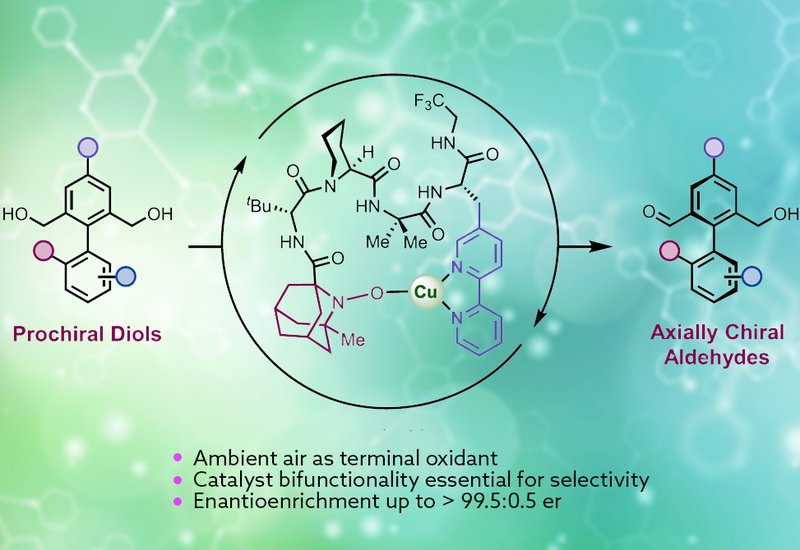
Axially chiral biaryl compounds appear throughout pharmaceuticals, natural products, and chiral ligand design, making their enantioselective synthesis a persistent target in asymmetric catalysis. Copper–aminoxyl cocatalytic systems can oxidize primary alcohols to aldehydes using ambient air as the terminal oxidant, but adapting this aerobic manifold to enantioselective transformations has proven difficult. The core obstacle is the bipyridine, bpy, ligand that coordinates copper during catalysis: despite the ligand's ubiquity in transition metal chemistry, efficient chiral versions capable of inducing high enantioselectivity have been rare. Prior work from Blandin et al. and from Szpilman et al. demonstrated proof of concept for atroposelective desymmetrization of biaryl diols, yet selectivity remained moderate across only a handful of substrates.
Researchers in the Miller Group at Yale University, published in the Journal of the American Chemical Society, built a bifunctional peptide catalyst that carries both an aminoxyl moiety and a bipyridine metal-binding unit within a single chiral scaffold. The key design choice was incorporating the unnatural amino acid (2,2′-bipyridin-5-yl)alanine, BpyAla, previously used in biocatalysis but never in small-molecule asymmetric catalysis, into an aminoxyl-containing peptide sequence derived from earlier work on meso-diol lactonization. The team synthesized enantiopure Boc-BpyAla-OH in six steps and coupled it into a peptide framework using solution-phase methods, producing the lead bifunctional catalyst P3.
The necessity of bifunctionality emerged immediately from catalyst screening. Aminoxyl-only peptide P1, evaluated alongside free bpy, and bipyridyl-only peptide P2, evaluated alongside an achiral aminoxyl, both afforded the desymmetrized monoaldehyde product as a racemic mixture. Catalyst P3, uniting both functions intramolecularly, delivered the same product in 0.5:99.5 enantiomeric ratio, er, and 43% yield in 3.5 h under ambient air at 0 °C. A systematic point-mutation survey of the peptide sequence confirmed that the relative stereochemistry of BpyAla and the other chiral residues, particularly the i+1 pipecolic acid residue, is critical to selectivity; replacing pipecolic acid with proline collapsed the er to 20:80. Reaction progress monitoring revealed that the er increased over time, reaching >99.5:0.5 er at 3.5 h, consistent with a combination of initial enantiotopic group selection followed by secondary kinetic resolution of the minor enantiomer of the monoaldehyde product.
Substrate scope studies across sixteen biaryl diols showed broad tolerance for ortho-substituted aryl rings, with bulkier substituents generally affording higher selectivity, and extended to heterocyclic substrates including pyridine- and thiophene-containing diols. The catalyst loading could be reduced to 1 mol% at room temperature while maintaining 4:96 er and improving monoaldehyde yield to 63%. Kinetic studies using in situ IR showed a first-order dependence of the initial rate on catalyst concentration, in contrast to the mixed-order dependence Stahl et al. observed with simpler achiral bpy ligands; the result points to a monomeric active species, with the peptide backbone's steric bulk disfavoring the Cu2O2 dimer invoked in achiral systems. DFT calculations corroborated this conclusion and revealed that catalyst P3 adopts a double β-turn hydrogen-bond network closely analogous to the earlier meso-diol catalyst, creating a conformationally constrained cavity around the copper center.
The Miller Group's work establishes BpyAla as a functional building block for small-molecule asymmetric catalysis, a role the amino acid had not previously filled despite its history in metalloenzyme design. The demonstration that cooperative action of an aminoxyl and a bipyridine within a single peptide scaffold can govern atroposelectivity opens a design principle applicable to other copper–bpy-catalyzed transformations. Because bipyridine coordinates a wide range of transition metals, these bifunctional aminoxyl–bipyridine peptides may serve as a versatile chiral ligand class well beyond aerobic alcohol oxidation. The authors note that ongoing studies in the laboratory are exploring additional enantioselective transformations enabled by this new catalyst family.